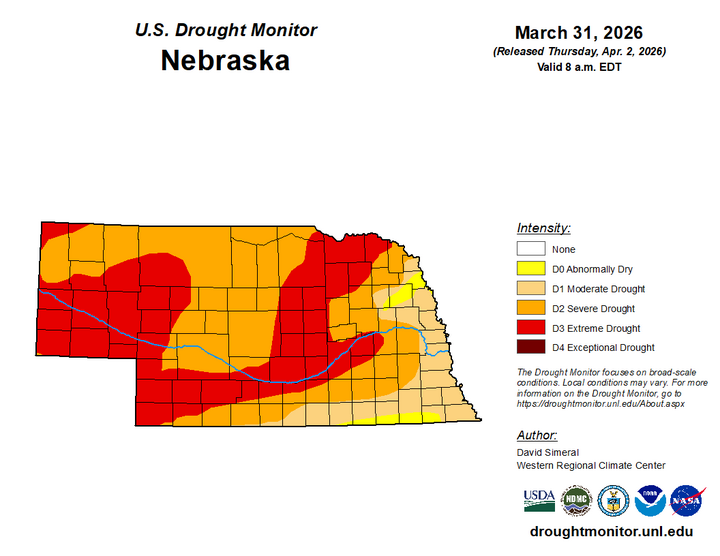
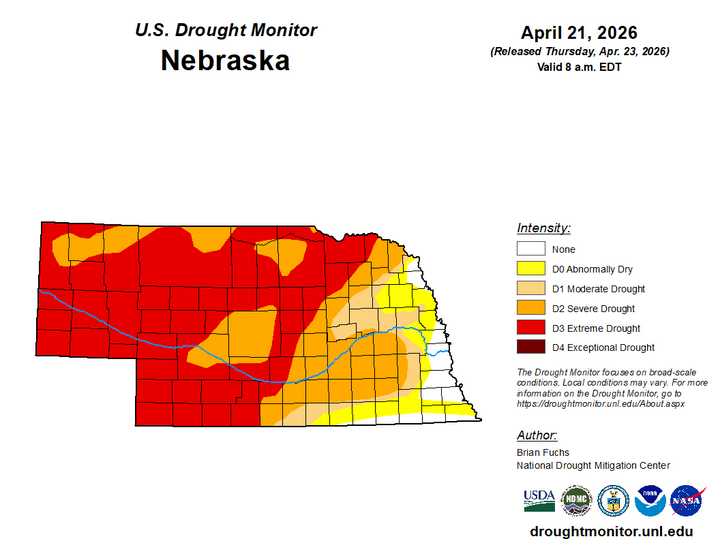
Extreme Drought Expanding
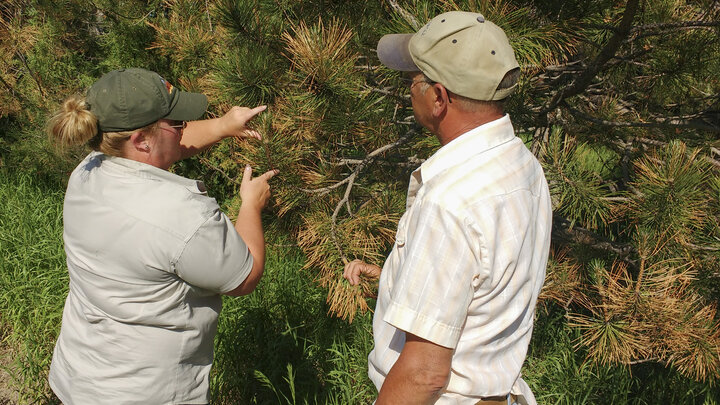
Extreme drought continues to expand throughout the state. Lack of regular snow fall over the winter in the front range of Colorado and other mountain states may cause a significant impact to western Nebraska's watershed. Rivers like the Platte, that depend on snow melt from the neighboring mountain states is currently below average but no at critical low levels at this time. If drought conditions continue this may have a negative impact on reservoirs that are fed by these waterways and thereby impact irrigation and water usage downstream. Trees in stress from drought can become susceptible to detrimental boring insects and canker diseases.

Late Freeze Affects Leaf Emergence Western Nebraska
Not only do trees in western Nebraska have to combat droughted conditions and fire, but they also had to contend with a mid-month freeze. Higher than normal temperatures in February and March caused early bud swell and, in some cases, early leaf emergence. During the weekend of April 18th, temperatures reached low enough and long enough to cause freeze damage on bud and leaf tissue.
Lowering additional tree stress can help the tree as it recovers. Watering and mulching will help. We advise to wait on applying any fertilizer and to wait on pruning out damage (unless hazards are apparent). Trees can be more resilient than we think and may recover just fine.
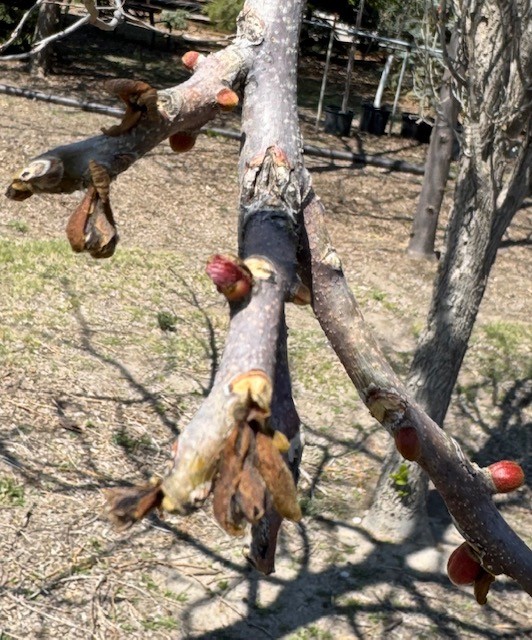
Photo courtesy of Bruce Hoffman
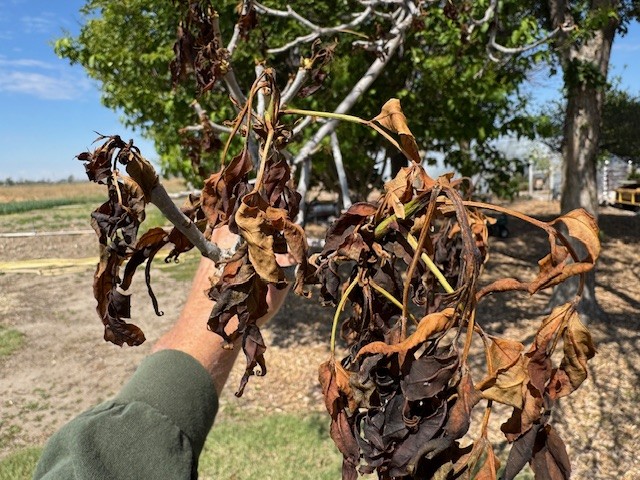
Photo Courtesy of Bruce Hoffman
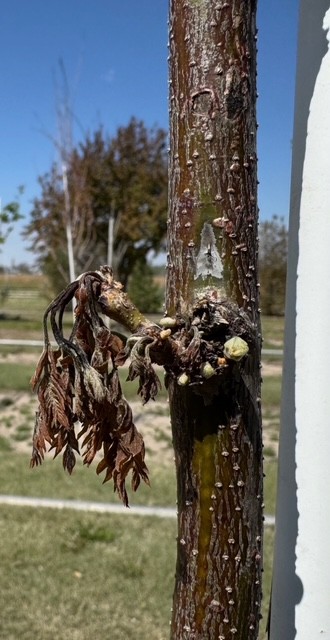
Photo Courtesy of Bruce Hoffman
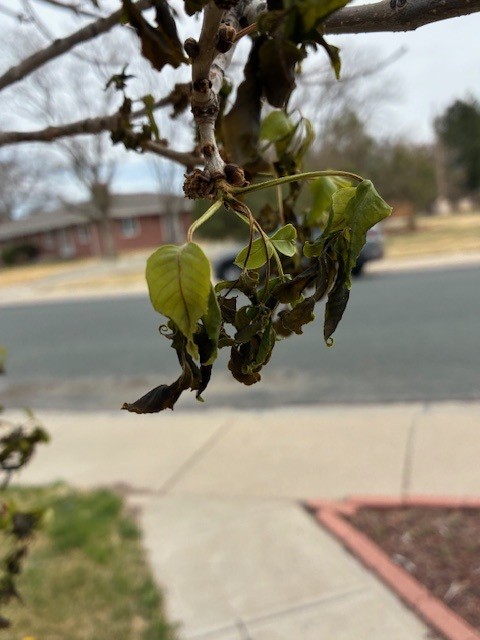
Photos Courtesy of Lauren Keefe
Current Emerald Ash Borer Detection Map
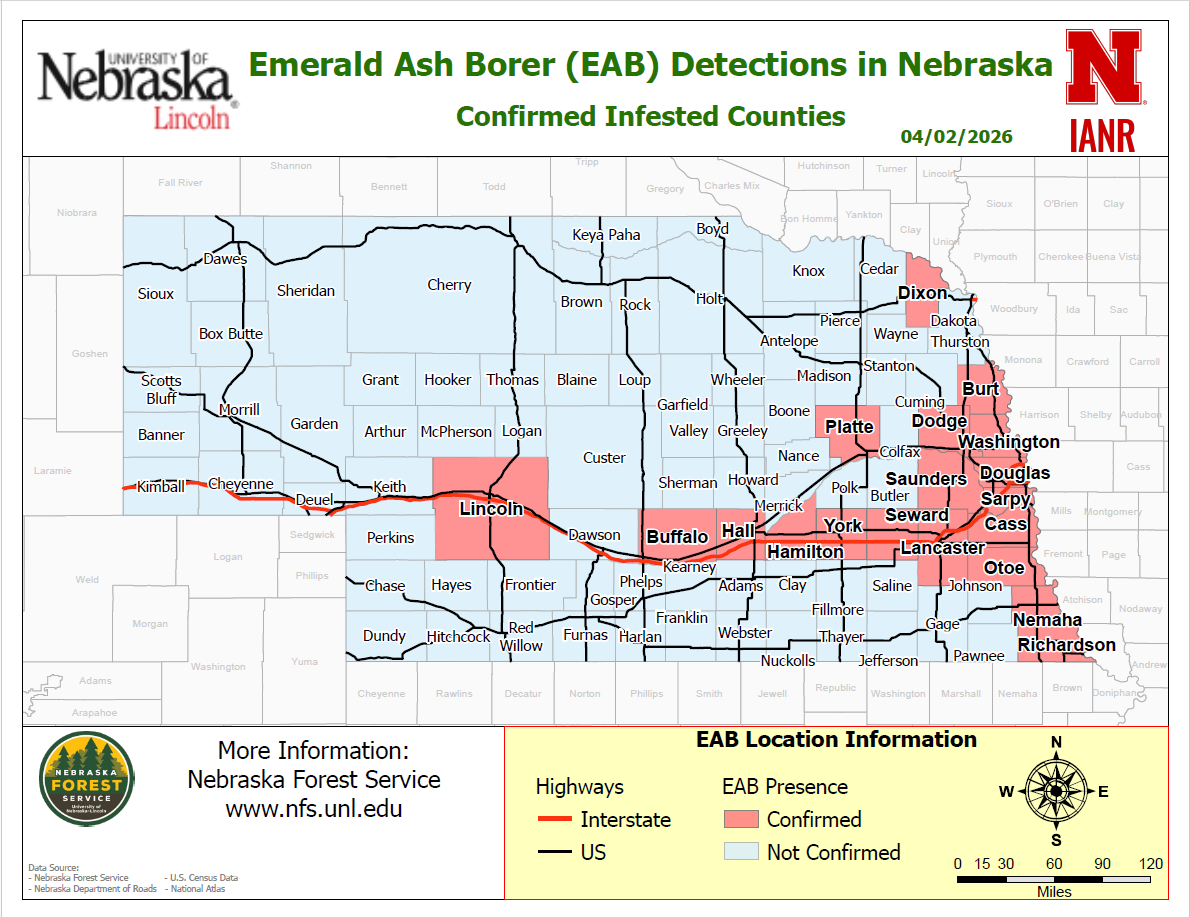
2026 surveys are currently underway for EAB, Spotted Lantern Fly (SLF), Thousand Canker Disease (TCD) and Elm Zigzag Sawfly (EZS). There are no known infestations of SLF and EZS nor any known infections of TCD in Nebraska. If you suspect these invasive pests or disease, please contact NFS.
Current Distribution of Thousand Canker Disease
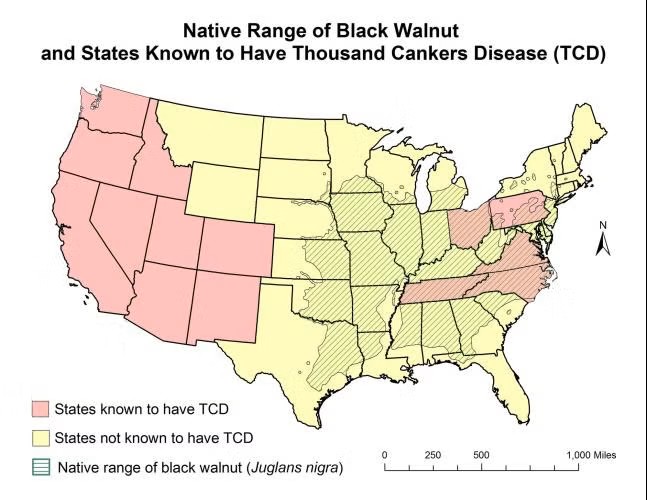
Map courtesy of Missouri Department of Conservation
Current Distribution of Spotted Lantern Fly
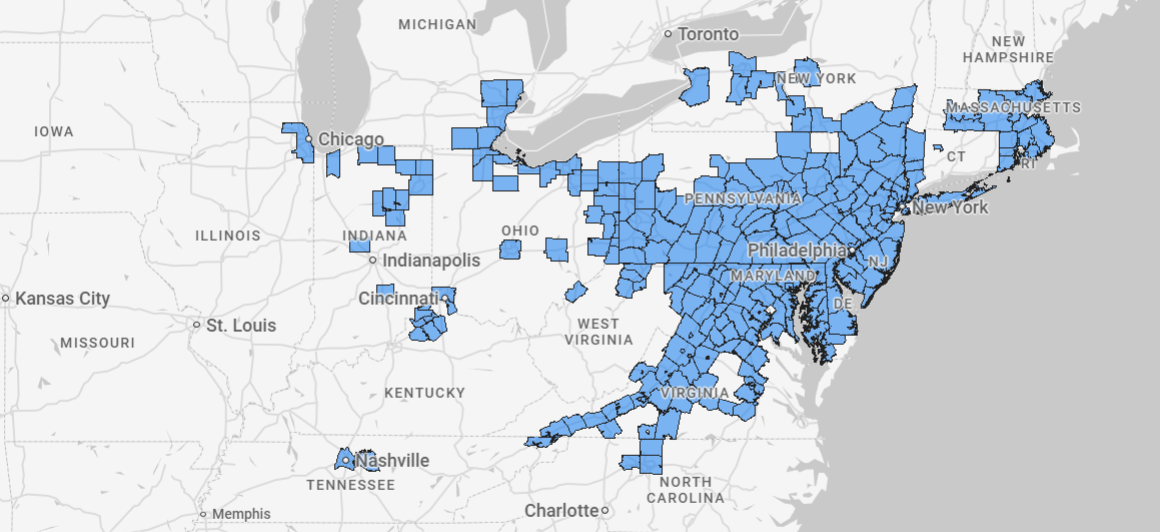
Map courtesy of Cornell CALS IPM
Current Distribution of Elm Zigzag Sawfly
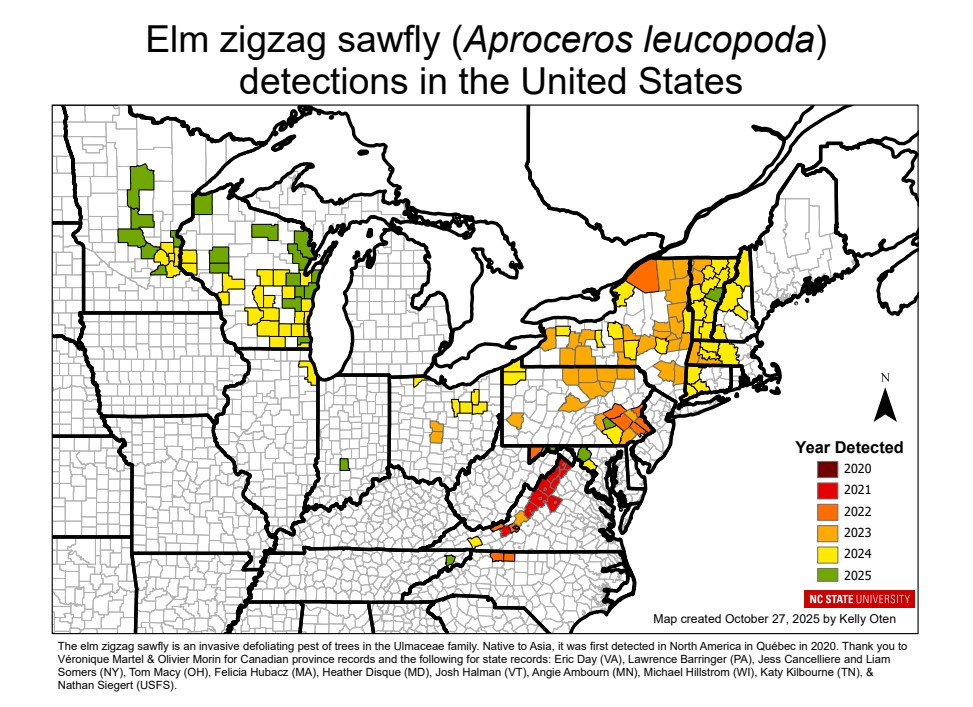
Map courtesy of Southern Regional Extension Forestry
Proper Planting Practices
A part of setting a tree up for success is planting correctly. Planting a tree can be intimidating for those that haven't had a lot of practice. Our website has a great page that explains how to plant and even provides a nice diagram for visual guidance. You can find this page here: https://nfs.unl.edu/tree-care/tree-planting-guide/
An important step that gets missed a lot is when planting a ball and burlapped tree or B&B tree for short, is the removal of the burlap, wires and ropes that hold the root ball together. If those are not removed, root problems can develop, especially girdling of the root system or girdling of the trunk from the rope and even roots drying out. Below is an example of a B&B spruce tree that was planted without removing the rope, burlap or the wire basket. The root ball was then covered with soil to create a berm. Even though the tree was watered, it died a few short weeks later.
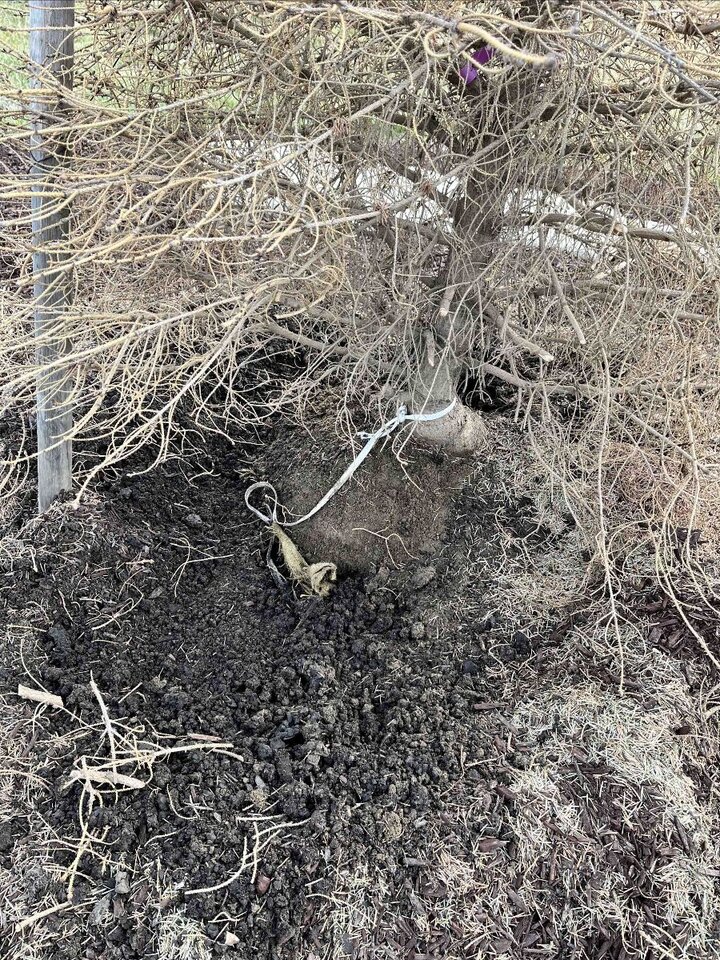
Picture supplied by Laurie Stepanek

Photos Courtesy of Laurie Stepanek
European Elm Flea Weevil
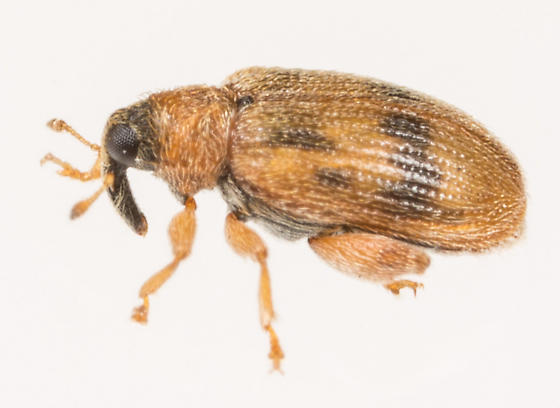
Notice the long snout, or rostrum, used in piercing tissue for feeding and creating holes in plant tissue for egg laying.
Photo courtesy of John Rosenfeld, Bugguide.net
The European Elm Flea Weevil in an invasive insect found in the US in the 1980's. This insect feeds on elm leaf tissue both as an adult and as a larva. Elm hosts are Chinese elm, Siberian elm and Asian elm hybrids. The adult will overwinter in ground debris or under loose bark around host trees. Adults will emerge typically in March-May and start feeding on the underside of elm leaves. The female will lay eggs shortly after emergence. Using her snout, the female punctures the leaf tissue and lays eggs next to the leaf veins or midrib inside the leaf. Larva, once hatched, mine in-between the top and bottom layer of the leaf, creating a meandering tunnel, coalescing into a large, browned blotch at the leaf tip.
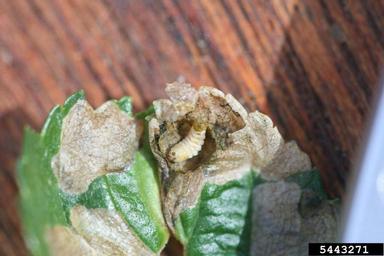
Photo Courtesy of Whitney Crenshaw, Colorado State University, Bugwood.org
Damage caused by this weevil is usually aesthetic but if populations are high, an infested tree may have excessive defoliation, causing additional tree stress. Treatment for elm flea weevil is typically not necessary. If higher populations are causing defoliation over several years, systemics labeled for elm flea weevils will help.
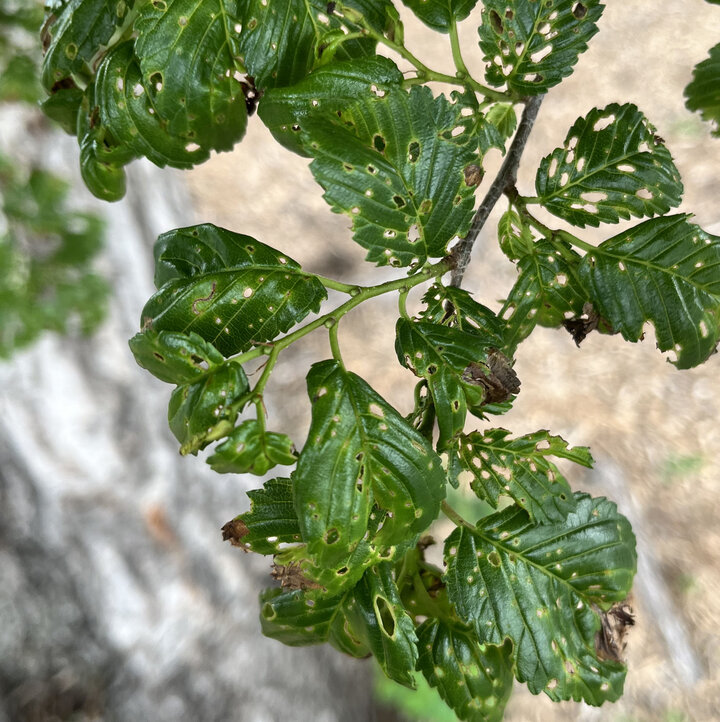
Photo Courtesy of Laurie Stepanik
More often than not, the elm leaf beetle, another insect that feeds on elm leaves, has been confused with the European Elm Flea Weevil. The damage is not the same. Elm leaf beetle is also an invasive insect from Europe that was introduced in the 1800's in the US and feed mainly on Siberian elm, but any elm can be a host. The adults also overwinter in leaf debris and loose bark on or near the host tree. Adults emerge in the spring and feed on leaf tissue before laying eggs. The leaf tissue will look lacy. After egg hatch the larva skeletonize the leaf tissue. Damage to the tree is mostly aesthetic unless populations are high. Overhead applications of insecticide or systemics labeled for elm leaf beetle will help in lowering populations.
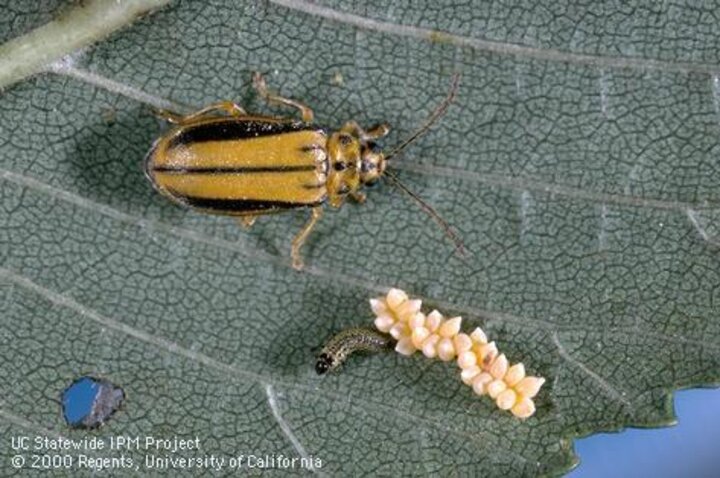
Photo Courtesy of UC Statewide IPM Project, University of California
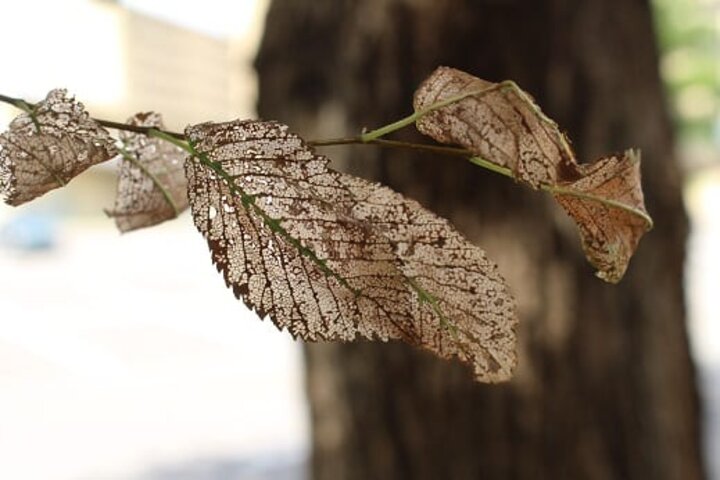
Photo Courtesy of Raymond Cloyd, KSU


